
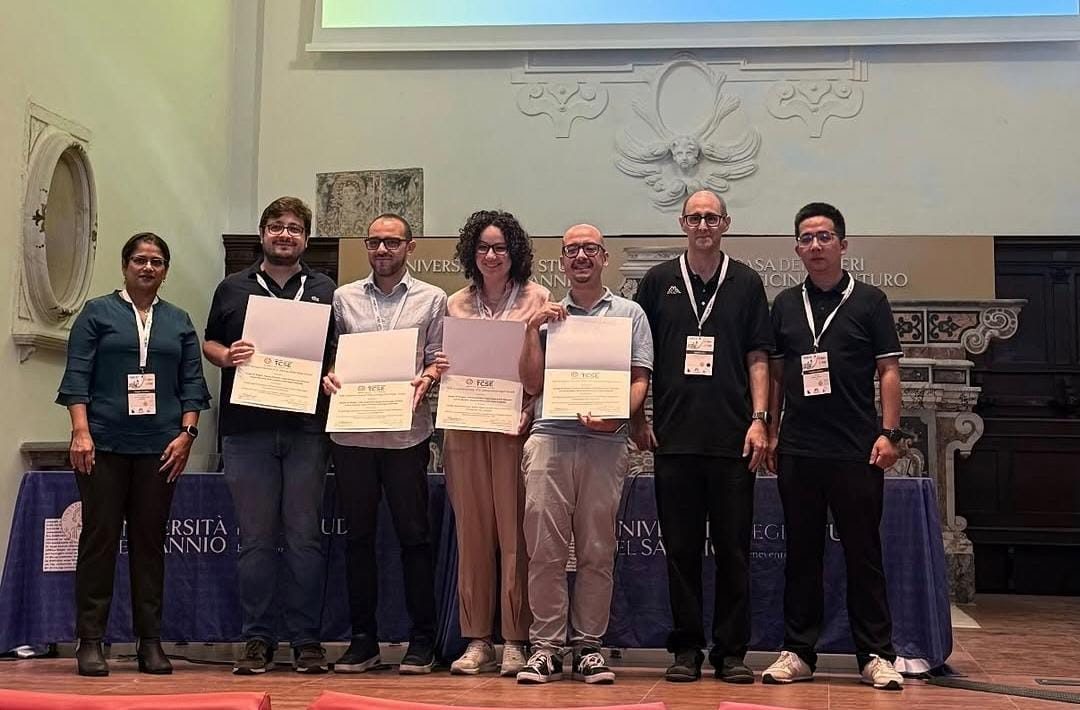
We are happy to share that our paper “Smelly Bad Practices in Performance System Tests: Detection, Prevalence, and Lifetime” has received a Distinguished Paper Award at the IEEE International Conference on Software Maintenance and Evolution (ICSME 2026).
The paper, authored by Sergio Di Meglio, Valeria Pontillo, Luigi Libero Lucio Starace, Luana Martins, Dario Di Nucci, and Fabio Palomba, is the result of a collaboration between the SQuIDS Lab at the University of Naples Federico II, the Gran Sasso Science Institute (GSSI), and the Software Engineering (SeSa) Lab at the University of Salerno. It was presented in the Research Track of ICSME 2026, held in Benevento, Italy.
When performance tests have smells too
Performance testing is crucial for assessing whether software systems can sustain realistic workloads and satisfy expected service levels. Yet the quality of the performance tests themselves is often taken for granted.
Our research investigates a simple question: what happens when performance tests are affected by recurring bad practices?
The ICSME study introduces PT-LINTR, an automated static-analysis tool for detecting bad practices in Apache JMeter test artifacts, and uses it to analyze 244 performance tests from open-source projects, including their evolution over time. The study considers ten detectable bad practices and shows that they are remarkably widespread: only one of the analyzed test artifacts was free from the investigated problems.
The longitudinal analysis also provides insights into when these problems appear and disappear. Bad practices are frequently introduced together with new or modified test code and tend to emerge close to software releases, when development activity and time pressure are typically higher. Their removal, instead, is more commonly observed away from release periods.
These results suggest that performance-test code deserves the same kind of systematic quality assessment that researchers and practitioners already apply to production code and other forms of test automation.
Receiving the ICSME Distinguished Paper Award is a wonderful recognition of this research effort and of the collaboration among the researchers and institutions involved.
Congratulations to the entire team! 🏆